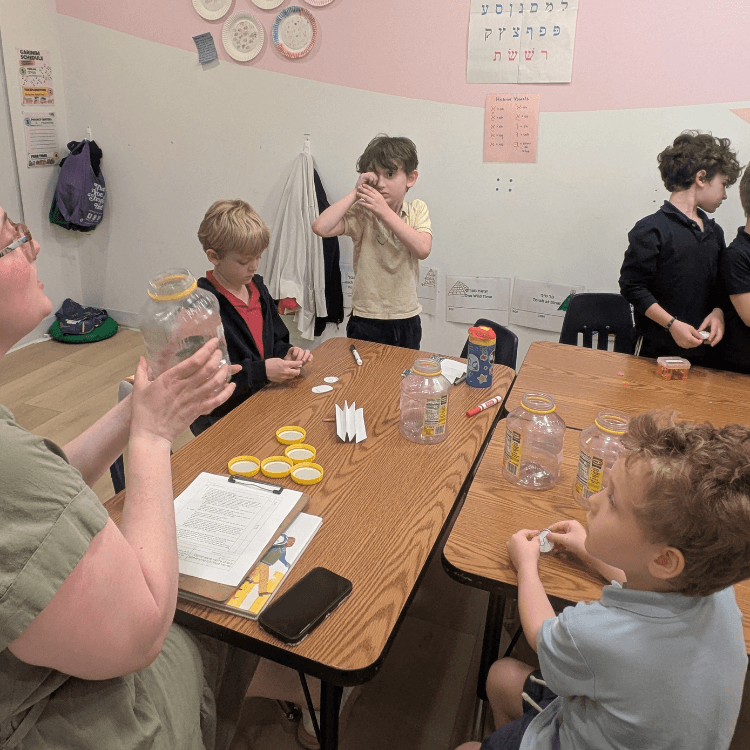
What better way to teach a lesson about sharing resources with everyone who needs them than by giving my Garinim (k-1st grade) learners little coins and letting them decide which organizations they would want to help? The goal of my lesson for this day was to explore the tension between the common instinct to take care of people who are like us and the Biblical command to make sure everyone has food to eat. We considered this tension in the context of the mitzvah (commandment, opportunity to connect) from Torah to leave behind the corners of our fields and the grain that falls during harvesting for the oni (poor person) and the ger (stranger) (Leviticus 23:22). We have also been learning about how Boaz makes sure that Rut gets not only what she needs survive, but a little more than that, when he identifies her as a kind and loyal member of his extended family.
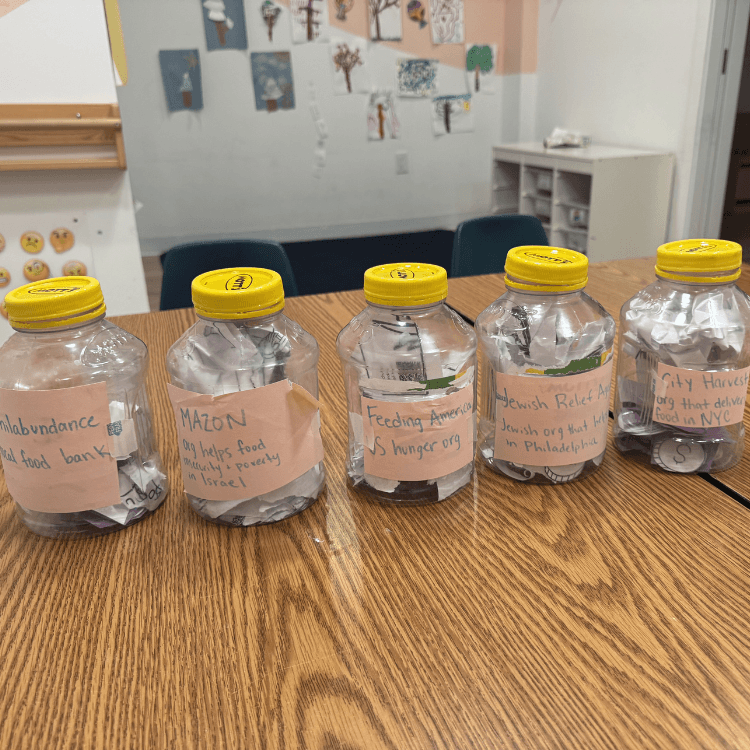
To play with the tension of choosing who to help and how much, I set up five jars, each labeled with a different organization: Philabundance (a local Philadelphia food bank), Feeding America (a US hunger relief organization), MAZON (an Israeli organization that helps with food insecurity and poverty), Jewish Relief Agency (a Philadelphia Jewish organization that helps people all across Philadelphia), and City Harvest (a NYC organization that rescues food and delivers for free to people who are hungry in NYC). Then, I gave each learner only three coins to distribute among the jars. No one could give equally to all of them, and I was curious to see whether the organizations being more Jewish, more local, etc., would influence the learner’s decisions.
I anticipated that this activity would be fun but challenging to choose who they would help among five options with only three coins. What I had not anticipated was that my learners would look at their coins, look at me, and ask, “where are the scissors?” The Garinim took one look at this task and determined that I had simply not given them enough coins, so they needed to make their own! As soon as one kid started making his own coins to make sure every organization would get help, the other kiddos joined right in. Before I knew it, I had a whole group of kids on the rug, drawing and cutting out their own coins to make sure each organization would get the help they duly need and deserve.
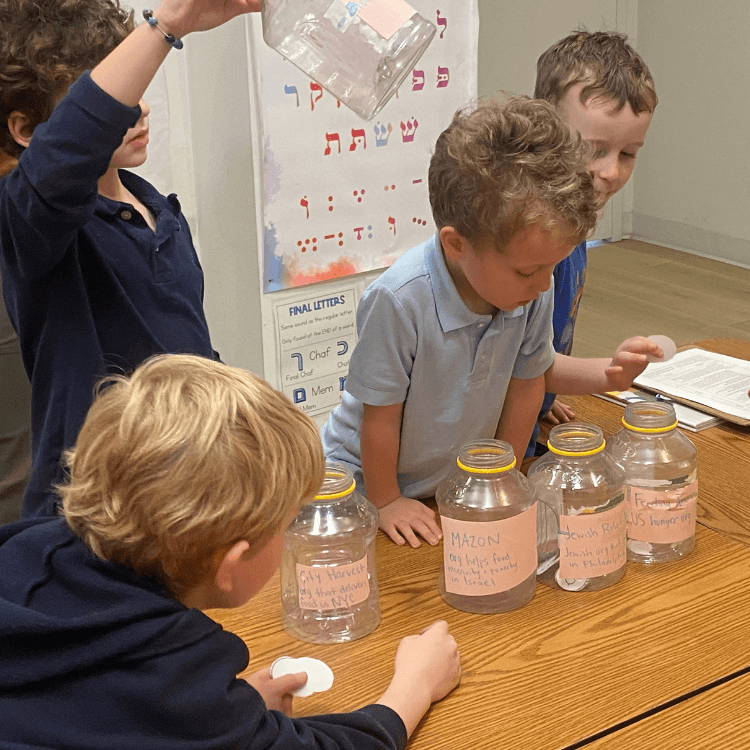
We had a conversation during this lesson about how we have the obligation to help everyone who needs it. I had given them five organizations to choose from, which were a mix of organizations that were “like us” and some that were “not like us.” The reflection that we all came away with by the end of the lesson was that we need to help everyone and that we need to make sure we have enough resources to do so. My challenge was seen as a way for them to show me that I had simply not provided them with what they needed, and they knew a way to change that right away!