Winter is a challenging time in learning environments! Holiday schedules and weather-related disruptions all interrupt routines and affect learners’ readiness to engage. Supporting children in becoming – and remaining – regulated enough to learn is a challenge! At Makom Community, we place particular emphasis on meeting learners where they are and making learning accessible. Since regulation challenges often intensify during the winter months, we selected the following Action Research question to explore proactive, classroom-based supportive strategies during this particularly vulnerable period:
How can teachers and learners work together to create a well-resourced classroom that supports learners in appropriately managing their own emotions and responding to the emotions of others? Observations informing this work were conducted between December 1, 2025, and January 23, 2026.
Our second Action Research cycle this year began by identifying and intentionally engaging with the most challenging moments of the Makom day. We focused on transitions – particularly from arrival into programming, and between prayer and other learning activities. Our Research Assistant, Nancy Gorosh, designed a brief intervention ritual intended to bring the class together and support emotional regulation through bilateral stimulation, to support nervous system regulation. This strategy emphasized cohesion within the classroom community and made regulation something everyone was working towards – ensuring that learners who need more support don’t feel singled out.
Learners doing bilateral stimulation.
Learners provided input on the ritual and shaped it over time. Among our youngest learners, changes were minimal. For example, altering the number of fingers held up on each hand, while maintaining the overall structure of alternating bilateral movements. Older learners (grades 5-7) engaged in more substantive discussion about the purpose of the ritual itself. They questioned whether its goal of “bringing the energy down” aligned with their needs at that point in the day. Learners noted that after school, particularly in winter, they often feel tired rather than overstimulated, and may benefit more from strategies that help them focus and mobilize their remaining energy.
As of early February, the older learners have agreed to a 30-second moment of silence during the transition between prayer and additional workshopping. During this time, they rearrange to have physical space from each other, and have a time for a visual cue for 30-seconds. Some learners take this time to take deep or rhythmic breaths. Other learners have stated their (continued) dislike of the ritual, but all learners participate, and the 30-seconds of quiet allows everyone a sensory break and time to regroup. We’re curious to continue to observe how this proactive strategy without whole-body, bilateral stimulation serves our learners.
Although the ritual requires only two to three minutes, it has contributed to noticeably calmer and more cohesive transitions into subsequent programming blocks. Learners use the time immediately following the ritual to gather regulation tools or seek educators for help. They’re able to plan for and proactively get what they need and then participate in the learning more fully, with a reduction in the number of reactive interventions offered by our educators.
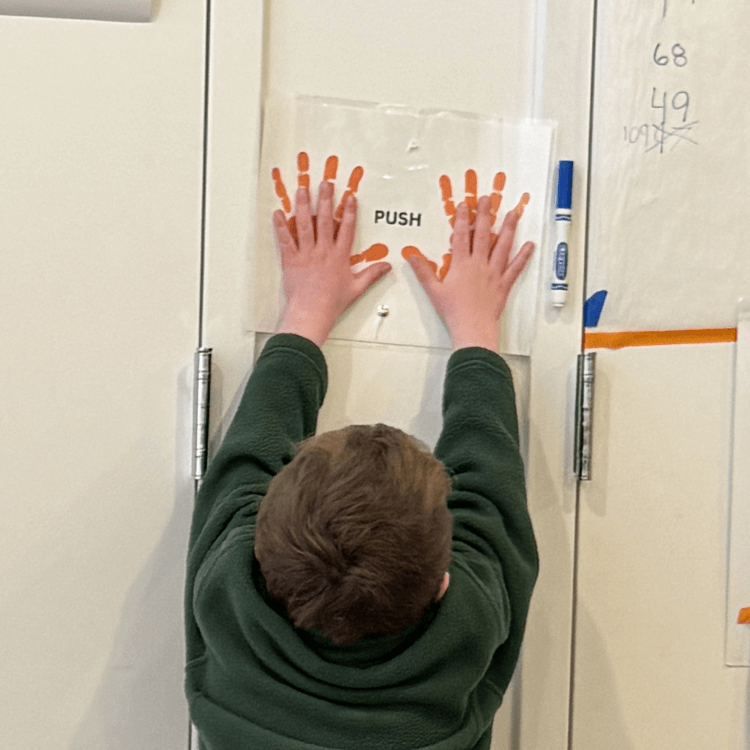
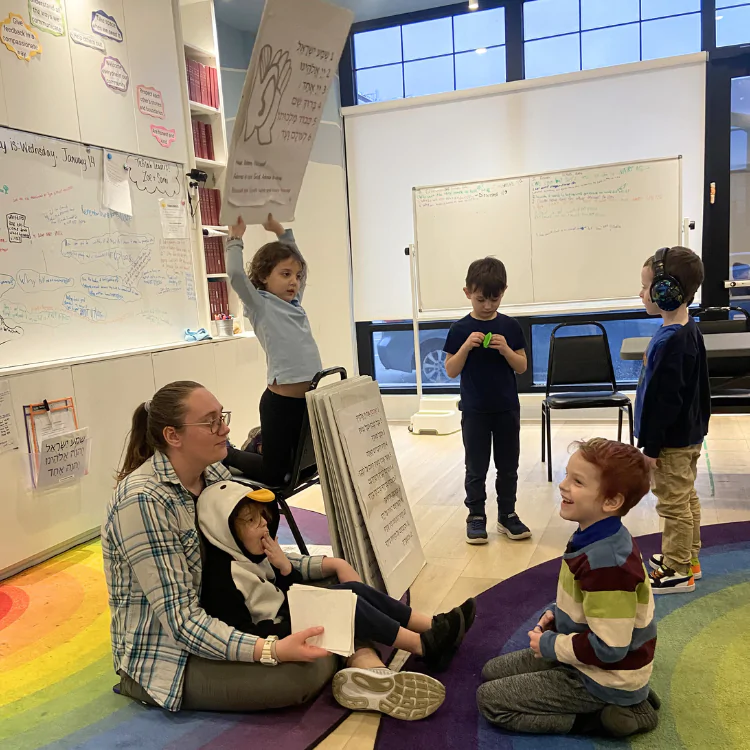
Alongside the opening rituals, we introduced poster resources for learners to access themselves, beginning with K–1 learners and later expanding to older cohorts with educator input. The most widely used resource across age groups was a “Push” poster, featuring an outline of hands and the word “Push.” Learners pushed against the poster until we discovered that pushing on the laminated posters ripped them! After that, learners quickly adjusted to pushing on the wall next to or beneath the posters when they needed a physical outlet. Once introduced, use of this resource was consistently learner-initiated. It was used at least three times per week during K–2 text study, approximately once per week during grades 3–4 text study, and around twice per week during services with learners in grades 3-7.
PDF of “Push” Poster can be found here.
Learners also made use of posters supporting paced breathing – such as dragon breaths for younger learners and square breathing for older learners – as well as regulatory tools already in classrooms. At the start of the unit, we conducted an inventory of these materials, including fidgets, blankets, comfort objects, and headphones. Learners were reminded of these options, after which most use occurred independently and without prompting from an educator.
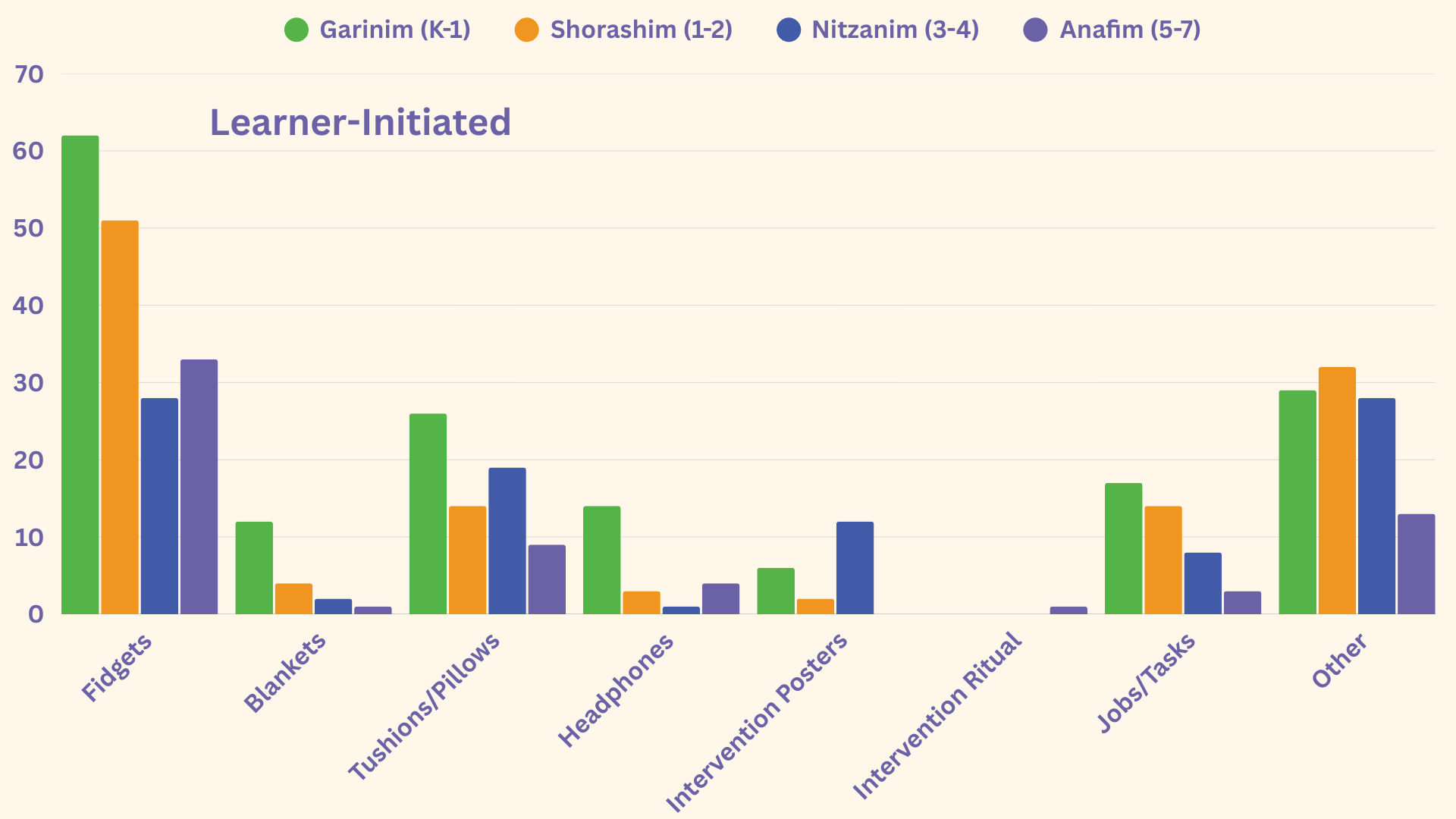
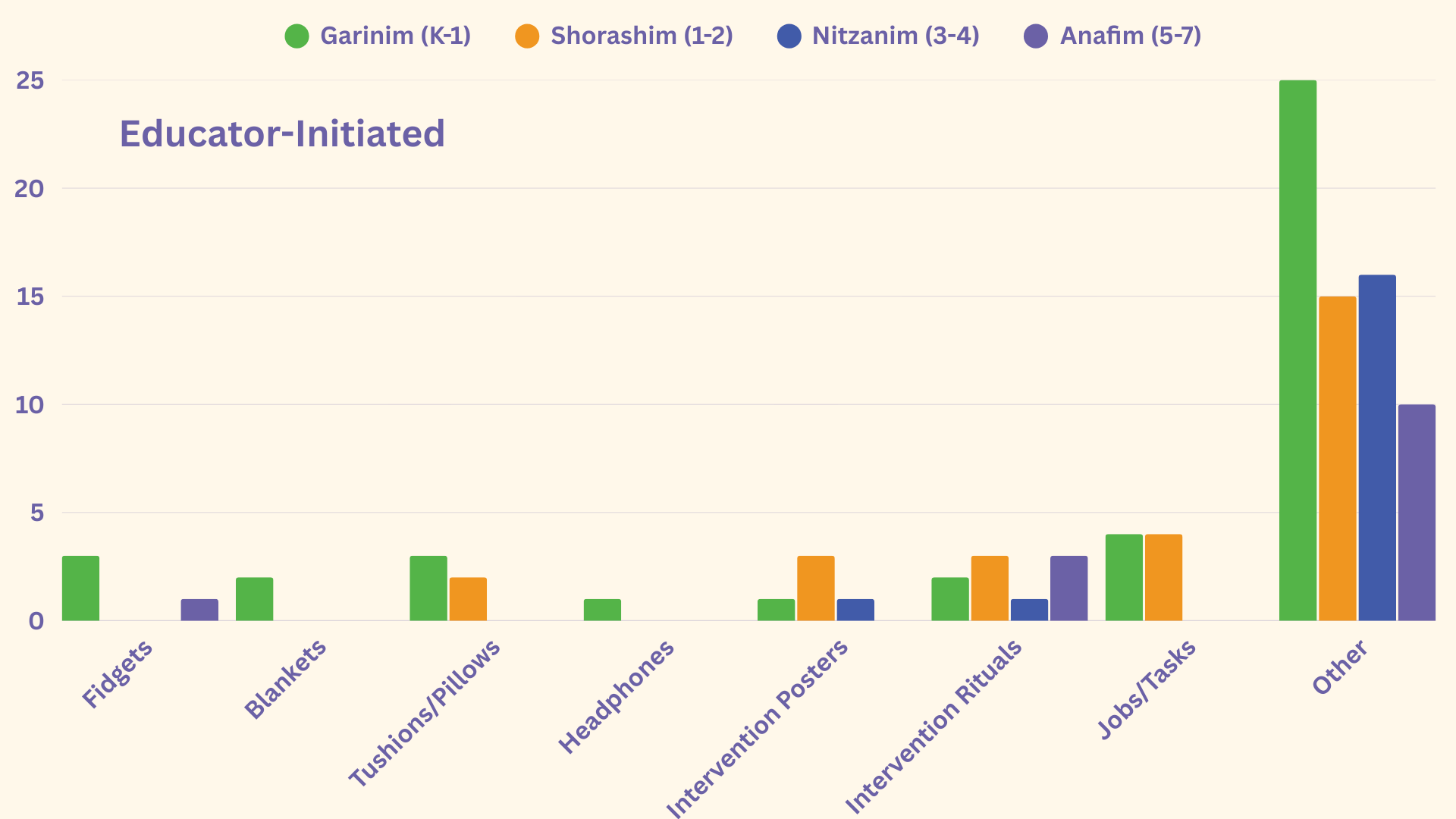
Inviting learners to take on specific roles or tasks, individually or collectively, also proved highly effective. Even learners who disengaged from other regulatory strategies, or from a particular moment of learning, often showed enthusiasm for concrete responsibilities, such as holding posters during prayer, pointing to letters during Hebrew work, or acting out portions of a text.
Both educators and learners initiated verbal check-ins and sought co-regulation when needed. That looked like learners readily expressing how they felt about activities and changes in plans. If they needed something to feel ready to engage – a hug, help finding a particular fidget, or to take some space to feel disappointed – they just asked. These practices, along with learner-specific accommodations, made up the majority of the “Other” category in our data tracking regulatory tool use. One of the most effective proactive strategies identified was clarity around expectations: clearly stated schedules and timelines, and explicit acknowledgment of changes to routines.
This research suggests potential value in expanding or iterating on this Action Research question to focus more explicitly on relational and interpersonal regulation skills. There is a clear connection to previous work supporting learners’ social and emotional development. Our observations point to a meaningful relationship between learner dysregulation and connection-seeking behaviors. That left us asking: How might we invest in growing social connection among our learners? Might that encourage a shift from reactive to proactive regulation? Other possible next steps for exploration could be identifying some of the significant moments of co-regulation or learner-specific accommodations that got rolled into the “Other” category within our tracking system and focusing our attention on them for future studies. We look forward to sharing our learning with you as it continues!