
What do a teahouse and the story of Purim have in common? I had no idea until I walked into the Nitzanim (3rd-4th grade) classroom after Beverly, our Executive Director and Founder, transformed it into a makeshift teahouse. Why did they do this, and what does it have to do with Purim? As a Jewish Placemaking Resident, I was excited to see what Beverly would try out and how it might offer me new options to bring our learning to life in compelling ways.
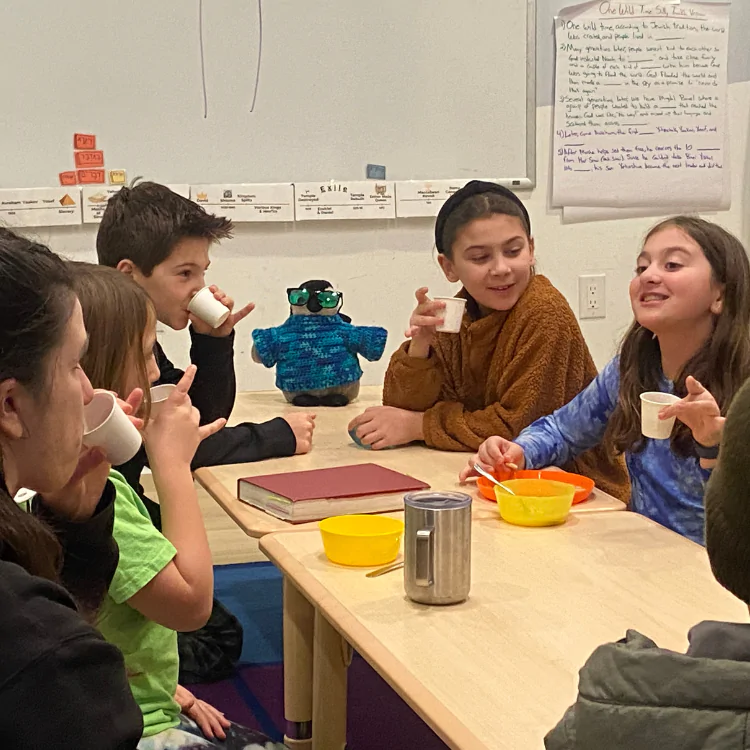
Beverly started modeling this by welcoming learners into the Nitzanim teahouse as they walked through the door. They invited learners to find a spot on a comfy tushion (cushion for your tush) around the communal table. Once settled, Beverly offered learners a little pre-poured cup of grape juice, playfully encouraging them to drink with their pinky up because it’s the Jewish month of Adar, and we can do fancy and silly things during Adar. Learners found numbered snippets of a summary of Megillat Esther under their tushions and took turns reading their excerpts. Between each excerpt, learners identified the main figures in the text, and took a vote on whether that person was a ger (stranger) or not, or in other words, were they “in” or “out.” Beverly modeled for me what guiding learners toward being able to empathize with the figures in a text looked like, and what we can learn from it just by being intentional about the physical setup and invitation they posed to the learners as they entered the room and continued with the learning.
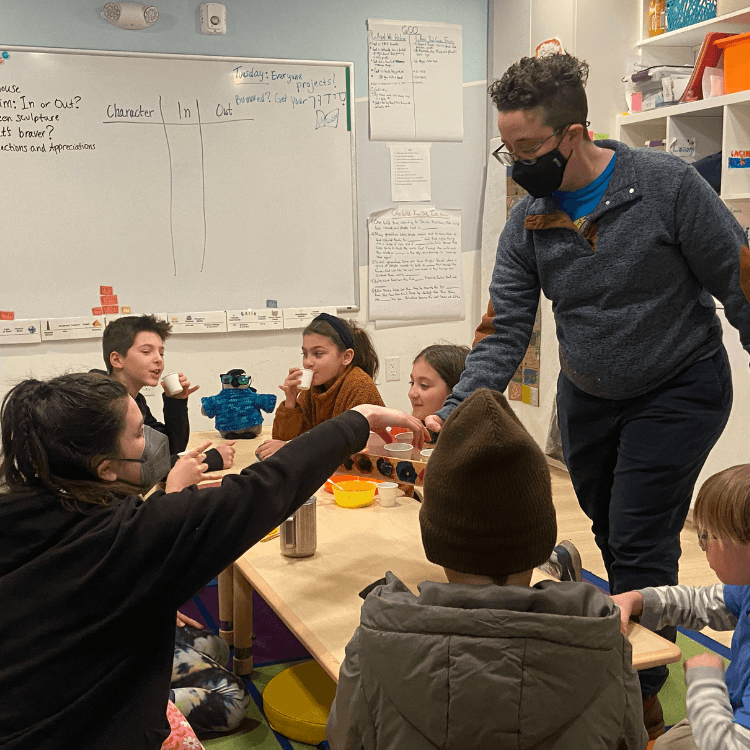
Later during the session, Beverly continued the lesson with the game “Frozen Sculpture,” inviting learners to empathize with Esther’s feelings leading up to her confrontation with King Achashverosh. During this activity, three learners came up to the front of the room. Beverly asked them: “What do you think it was like for Esther to approach the king uninvited, knowing that if he didn’t extend his scepter to her, she could die?” One learner showed their impression of Esther’s face, one shared what they imagined were Esther’s feelings, and the third spoke as if they were Esther’s inner monologue. Including an additional modality for perspective and empathy-taking – while learners were already taking turns reading the text aloud and responding with thumbs or hands up or down, to some of the questions – offered a more rigorous approach to text study I hadn’t experienced before.
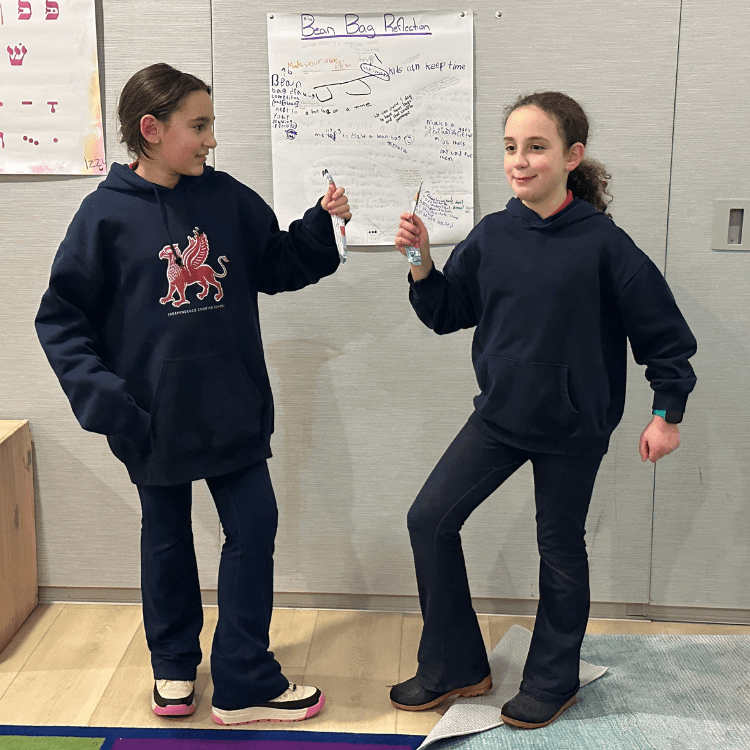
Having the opportunity to learn, reflect, and practice more approaches at Makom to engage learners in compelling ways over the past several months has been the type of learning and growing experience that I’d been looking for as a Jewish educator. Makom’s methodology doesn’t just invite educators and learners to engage with Jewish text as is. It invites us to find ways to create different access points for our learners to understand, empathize with, learn from, and see themselves as being a part of this larger table/community that is Jewish Wisdom. I am incredibly grateful for the opportunity to be a part of it and welcome others to it.